Why IT Automation Projects Fail (And How to Fix Them)

Vlad Shlosberg
Founder
Automation has become one of the clearest priorities in modern IT, but it has also become one of the easiest priorities to overstate.
Most teams agree on the broad objective. They want fewer manual steps, faster approvals, cleaner provisioning, less repetitive triage, and better operational consistency. The intent is rarely the problem. The challenge is that automation projects are often launched at the point of visible pain, but before the underlying workflow has been clarified well enough to automate successfully.
That is why so many automation efforts stall, underperform, or quietly drift into maintenance mode without delivering the expected value.

The Real Problem: Process Ambiguity, Not Technology
The usual explanation is that the tooling was not mature enough or that the integration work proved harder than expected. Those things certainly happen. But more often, automation fails because it is being asked to solve process ambiguity rather than process execution.
This is an important distinction.
Automation is highly effective when a workflow is repeatable, structured, and understood. It struggles when the workflow exists largely as tribal knowledge, varies depending on who is handling it, or depends on decisions that were never formalized in the first place. In those cases, automation does not create clarity. It forces the lack of clarity into the open.
That is often why projects feel harder than they looked at the outset.
Why Automation Projects Stall
In our conversations with customers, this pattern is familiar. A team wants to automate onboarding, software approvals, or intake routing. The use case is valid. The pain is real. But once the design process begins, a series of unresolved questions emerges:
- Who actually owns the workflow?
- What data is authoritative?
- Which approvals are required and under what conditions?
- What happens with contractors, exceptions, urgent cases, or role changes?
- Which system initiates the process, and which system should record the final state?
These are not secondary implementation details. They are the workflow.
Without them, automation has no stable foundation.

Five Common Failure Patterns
Several failure patterns appear repeatedly across organizations:
1. Automating an Unstandardized Process
If the same request is handled differently by different people, any automation effort will either fail, become overly complex, or codify inconsistent behavior. A team often believes it has one process when in fact it has a set of informal variations that happen to produce broadly acceptable outcomes.
2. Lack of Clear Ownership
Workflows that span IT, HR, security, finance, and line managers can create a diffusion of accountability. Everyone participates, but no one is clearly responsible for design decisions, exceptions, or ongoing refinement. That makes automation fragile because changes to the workflow require coordination across stakeholders who may not share the same priorities.
3. Scope Inflation
Automation initiatives frequently begin with one high-value use case and quickly absorb adjacent goals: approvals, routing, provisioning, reporting, notifications, asset coordination, exception logic, and self-service all at once. While the ambition is understandable, it can produce too much complexity too early. Teams end up building for the full operating model before proving value in a narrower slice.
4. Underestimating Edge Cases
Every workflow has exceptions, but in some environments the exceptions are common enough that they should be treated as core design inputs. Temporary staff, region-specific policies, multiple approval paths, and variable entitlements can all undermine an otherwise clean automation design if they are discovered too late.
5. Absence of Post-Launch Governance
Automation is not static. Workflows change, source systems evolve, teams reorganize, and approval structures shift. If no one measures completion rates, fallback patterns, manual interventions, or failure points, the workflow may appear functional while gradually creating more invisible work behind the scenes.
How to Fix It: A More Disciplined Approach
The good news is that most of these problems can be addressed with a more disciplined approach.
Start with Workflow Mapping
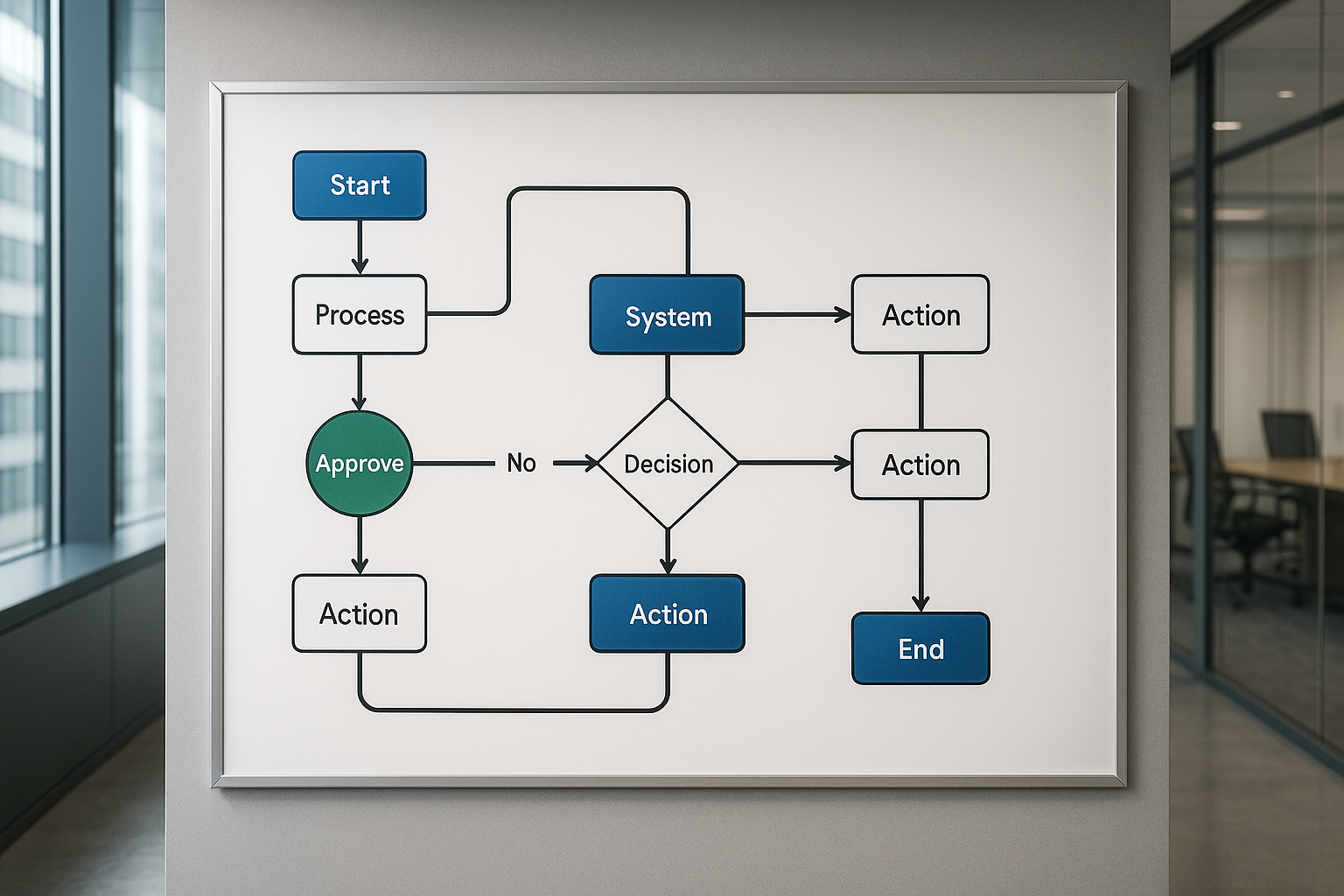
The strongest automation efforts begin with workflow mapping, but not in the abstract. The team needs to understand the actual operational sequence as it happens today:
- What triggers the work?
- What information is required?
- What conditions change the path?
- Which approvals are needed?
- Which systems act?
- What exceptions appear most frequently?
That process often feels less exciting than choosing a platform or building a prototype, but it is usually the point at which the real success of the project is determined.
Select the Right Use Case
The next step is selecting a use case that is both painful and repeatable. Good candidates are typically high-volume processes with a predictable shape: software access, onboarding, approval routing, simple triage, or routine provisioning. The goal is to start where the workflow is clear enough to automate and the improvement is visible enough to matter.
Establish Clear Ownership
Ownership must also be explicit. Cross-functional participation is often necessary, but accountability should still rest with a clearly designated workflow owner. Without that, automation becomes difficult to maintain because every adjustment turns into a negotiation rather than a managed decision.
Design for Exceptions
It is equally important to design for exceptions rather than treating them as an afterthought. Good automation knows when to continue and when to hand off. A workflow that can recognize its own limits is more resilient than one that tries to force every case into a happy path.
Create a Measurement Loop
Finally, teams need a measurement loop. Successful automation should reduce effort, increase consistency, and improve cycle time or service quality in observable ways. If those effects are not being monitored, it becomes difficult to distinguish a valuable automation layer from a visually impressive one.
The Bottom Line
In the end, the most successful IT automation projects are rarely the most technically elaborate. They are the ones built on honest process understanding, disciplined scope, clear ownership, and a willingness to refine the workflow over time.
Automation does not fail because it is overhyped. It fails when it is treated as a shortcut around operational design.
Handled well, it is not a shortcut at all. It is the result of good design.
And that is why the teams that do it well tend to improve not just one workflow, but the way they think about service operations more broadly.
Ready to build automation that actually works? Learn how Foqal helps IT teams design, deploy, and maintain automated workflows that integrate seamlessly across Slack, Teams, and your existing tools.
Subscribe to our newsletter
Get the latest insights on IT operations, AI, and workplace productivity delivered to your inbox.
Ready to transform your support?
See how Foqal can help your team deliver faster, smarter support.
Start Free TrialRelated Articles
The Problem with AI IT Support Bots
Discover why AI support bots often fall short and how a hybrid approach—combining AI‑driven knowledge retrieval with human‑guided workflows—can turn AI into a powerful accelerator for IT service delivery.
The Future of IT Onboarding: Fully Automated Day-1 Workflows
Discover how fully automated Day‑1 workflows transform onboarding from a chaotic checklist into a seamless, secure experience that boosts efficiency and showcases IT’s strategic value.
Why Every IT Team Is Becoming an Automation Team
Discover how modern IT teams are shifting from routine support tasks to strategic automation, turning repetitive workflows into streamlined, scalable processes that boost efficiency and reduce toil.